Counterpoint Forecasts DRAM Demand From Humanoid Robots Could Rise 20-Fold by 2030
10/18/2026 / By Edison Reed
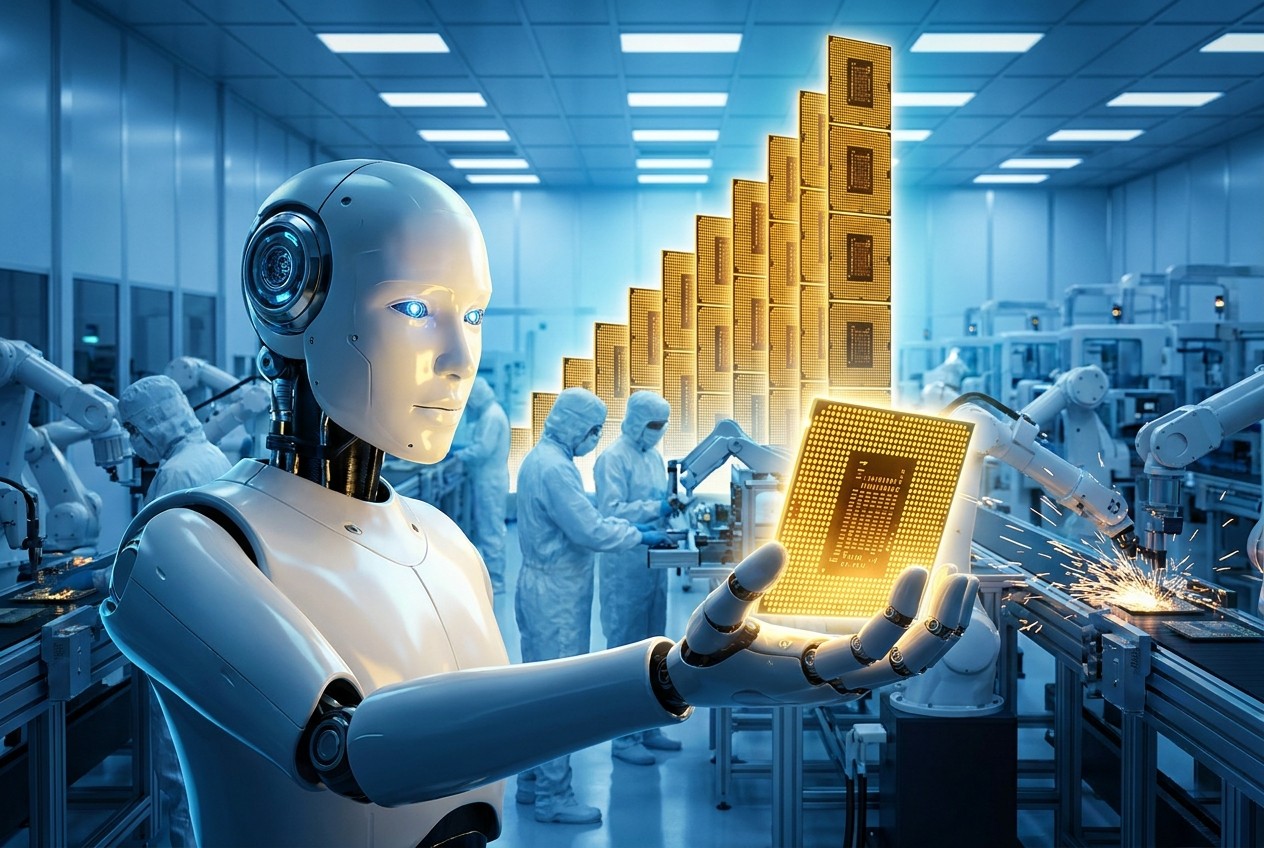
Dynamic random-access memory (DRAM) demand tied to humanoid robots could climb more than 20-fold by 2030, according to a Counterpoint Research note first cited by the South Korean newspaper Chosun Daily.
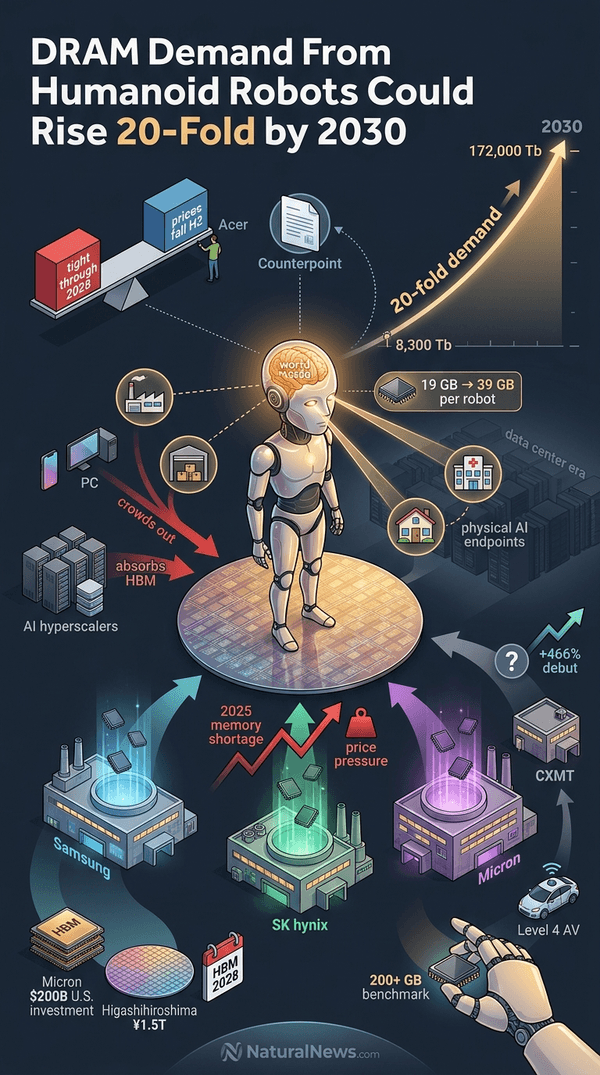
The firm estimates robot-industry DRAM demand will rise from roughly 8,300 terabits this year to approximately 172,000 terabits by 2030 [1][2]. Counterpoint also projects that average DRAM capacity per humanoid robot will roughly double over the same period, from 19 gigabytes to 39 gigabytes [3]. The forecast positions physical AI — artificial intelligence deployed in machines outside data centers — as a potential new source of memory demand, according to the research firm.
The note attributes the projected increase to more sophisticated AI models, which carry larger memory requirements. Counterpoint said humanoid robots process images, video and sound simultaneously and use “world models” to anticipate changes in the surrounding environment, requiring faster processing and greater memory capacity [3]. The forecast arrives as humanoid robot DRAM demand is projected to surge twentyfold by 2030, making robots a new growth driver for Samsung Electronics and SK Hynix [4].
Memory Market Tightness and Samsung Earnings
The projected robot demand emerges against a backdrop of a global memory shortage that began in 2025, driven by supply constraints and rapid price escalation in the semiconductor memory market, particularly affecting DRAM and NAND flash integrated circuits [5]. AI hyperscalers have absorbed high-bandwidth memory for data center buildouts, sending prices higher and pressuring consumer electronics companies [3].
Some industry figures have offered a different timeline. Jason Chen, chairman and CEO of Taiwanese PC maker Acer, said last month that chip prices could begin falling in the second half of next year [3]. That assessment contrasts with warnings from major memory manufacturers, who continue to signal tight conditions through next year [3].
Goldman analysts said they are looking to Samsung’s Oct. 29 earnings report for indications of whether the company expects tight memory-market conditions to persist in 2028 [3]. Separately, Chinese memory-chip manufacturer ChangXin Memory Technologies, known as CXMT, recently said it had begun mass production of advanced memory chips [3]. The company’s DRAM business has gained visibility after its shares surged 466% in its July 27 market debut on the Shanghai Stock Exchange’s STAR Market, making it mainland China’s most valuable listed company [6].
Robot and Autonomous Vehicle Demand
Memory requirements for highly autonomous machines provide context for the robot forecast. Micron CEO Sanjay Mehrotra said, “Level 4 or higher autonomous vehicles typically require over 200 GB of memory and several terabytes of storage. Humanoid robots will likely need similar levels of memory and storage” [3].
On the humanoid supply side, Eric Sheridan, managing director and internet/e-commerce equity analyst at Goldman, raised his base-case forecast to 75,000 humanoid shipments in 2026, 890,000 in 2030 and 6.5 million in 2035, versus previous estimates of 51,000, 256,000 and 1.4 million [3]. Sheridan told clients in late August, “We are raising our humanoid robot market forecast. The global market is now projected to reach approximately 890,000 units by 2030 and 6.5 million units by 2035 (representing a $138 billion market opportunity)” [3].
Global memory firms are eyeing the robot market, according to the report [3]. Estimates of the economic scale involved vary widely; earlier commentary on the robot segment projected a possible market bifurcation between lower-cost Chinese robots and higher-cost American platforms [7]. The capital intensity of the underlying supply chain remains substantial, with Micron having expanded its U.S. investment to $200 billion, including $150 billion for manufacturing and $50 billion for research and development [8].
Supply Response and Outlook
Major memory giants continue to warn of tight conditions through next year, while CXMT’s supply is coming online, according to company statements and analyst notes [3]. The tight-memory narrative may be tested after Samsung’s earnings call, Goldman analysts said [3].
Counterpoint’s forecast indicates DRAM demand could surge beyond data centers as humanoid robot deliveries are expected to begin next year and continue through the decade [3]. Memory demand will likely also rise for highly autonomous vehicles, which typically require over 200 GB of memory and several terabytes of storage, according to Micron’s CEO [3].
Supply-side developments remain uneven. Micron broke ground on a ¥1.5 trillion ($9.3 billion) expansion of its Higashihiroshima, Japan, factory, with high-bandwidth memory shipments expected to begin around the summer of 2028 [9]. CXMT’s emergence as a large domestic DRAM producer — alongside Chinese NAND maker YMTC — has introduced new competitive pressure on the established suppliers, according to industry reporting [10].
Conclusion
Goldman has raised its humanoid robot shipment forecast to 890,000 units by 2030 and 6.5 million by 2035, citing a $138 billion market opportunity [3].
Memory makers and analysts are awaiting Samsung’s Oct. 29 earnings report for signals on whether tight market conditions will persist, according to Goldman [3]. Acer’s CEO has said chip prices could begin falling in the second half of next year [3].
The outlook depends on supply additions such as CXMT’s mass production and the pace of humanoid robot deliveries [3]. The humanoid robot category itself remains early in commercialization, and independent commentary has questioned how quickly household robots will reach mass deployment [11].
References
- New DRAM Demand Source Could Surge 20-Fold By 2030. https://www.zerohedge.com/technology/new-dram-demand-source-could-surge-20-fold-2030
- Humanoid Robot DRAM Demand to Grow 20-Fold by 2030 …. https://finance.biggo.com/news/c063a8c4-6fe7-4e42-a5d4-767d57d3ad32
- New DRAM Demand Source Could Surge 20-Fold By 2030. https://www.zerohedge.com/technology/new-dram-demand-source-could-surge-20-fold-2030
- Robot DRAM Demand to Jump 20-Fold by 2030, Samsung and SK Hynix Eye New …. https://en.sedaily.com/finance/2026/10/11/robots-emerge-as-next-growth-driver-for-samsung-sk-hynix
- 2025–present global memory supply shortage – Wikipedia. https://en.wikipedia.org/wiki/2025%E2%80%93present_global_memory_supply_shortage
- Chinese Memory Chip Maker CXMT Delivers Blockbuster IPO – NaturalNews.com, July 29, 2026.
- Bright Videos News – GOLD AND SILVER BATTERY CHEMISTRY FIASCO – Mike Adams – BrightVideos.com, June 10, 2026.
- Micron expands US investment to 200 billion amid Trump push to onshore semiconductor supply chains – NaturalNews.com, June 17, 2025.
- Micron Breaks Ground on $9.3 Billion Hiroshima Memory Chip Plant – NaturalNews.com, July 08, 2026.
- Chinese semiconductor firms CXMT and YMTC dominate global memory chip market – NaturalNews.com, June 01, 2026.
- The Robot Revolution in Your Home Dont Hold Your Breath – NaturalNews.com, May 08, 2026.
Explainer Infographic
Submit a correction >>
Tagged Under:
chip makers, computer memory, computing, counterpoint, current events, dangerous, DRAM, DRAM chips, dynamic random-access memory, future tech, glitch, humanoid robots, products, robotics, robots, supply chain warning, technology
This article may contain statements that reflect the opinion of the author
RECENT NEWS & ARTICLES